
On 13 November 2026, in a classroom of Lingnan University’s OPEM (Organisational Psychology and Education Management) programme, the speaker did not begin with a string of diagnostic labels. Instead, he opened with a question to the postgraduate students:
When we see a young person behaving inappropriately, how much do we really understand?
The session was titled “Beyond the Diagnosis” and led by Mr Diao Demou, Project Lead at the Hong Kong Child and Youth Mental Health Association and a Lingnan University alumnus. A fictional young person, “Demo”, carried the class throughout: from arguments with his father over homework at ten, to involvement in bullying and conflict at fourteen, to repeated aggressive outbursts at seventeen. Rather than rushing to decide “what is wrong with him”, the class set out to practise a different capacity — seeing the person behind the behaviour.
This article brings together the main content of the session, for those who could not be there in person.
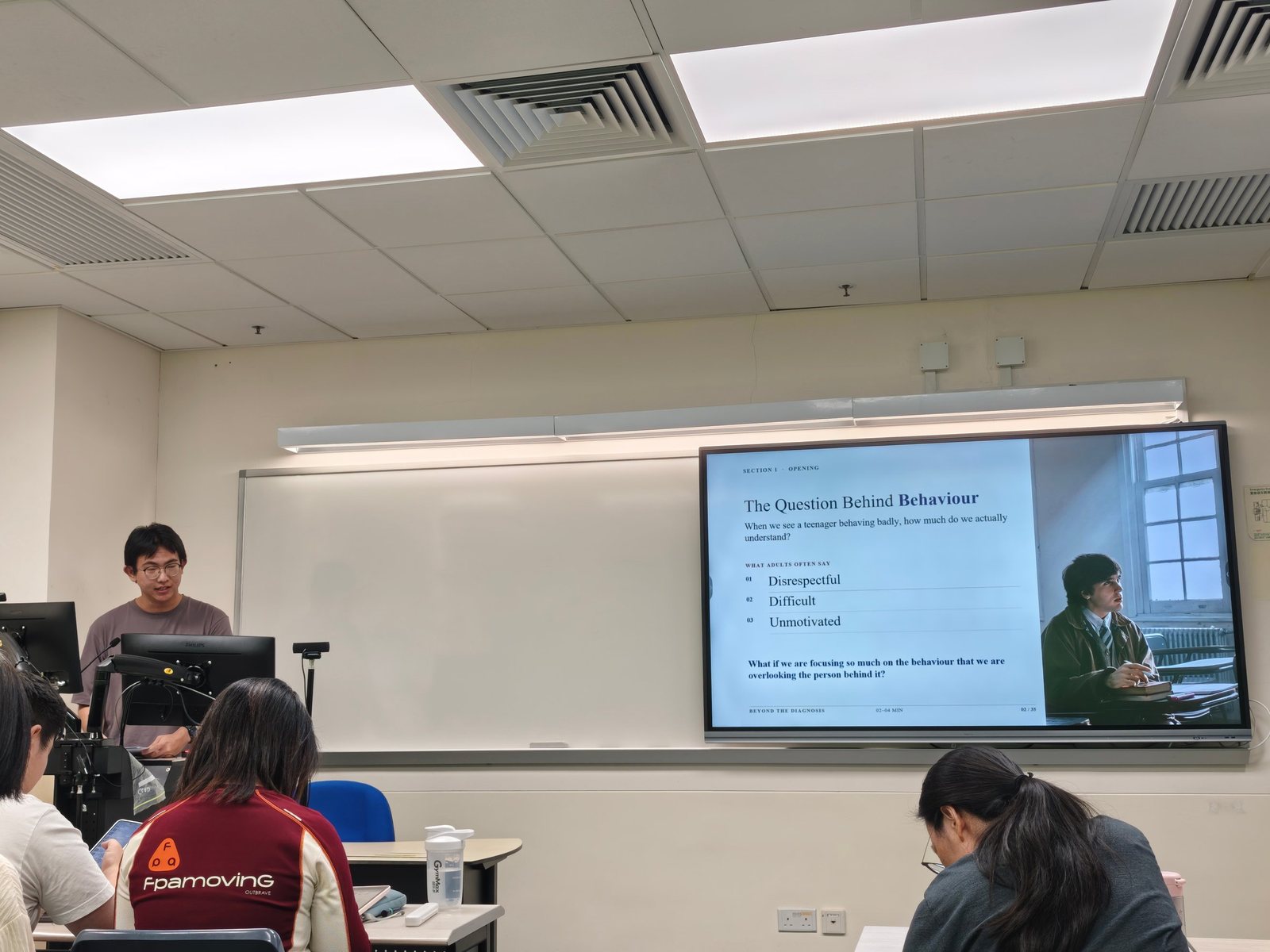
1. Who is behind the behaviour?
A student refuses to follow instructions, talks back to a teacher, interrupts the lesson, and occasionally becomes aggressive. In these situations, an adult’s first reaction is often: disrespectful, difficult, unmotivated, or even “deliberately disruptive”. The speaker said that such reactions are understandable: teachers and parents have a responsibility to keep order, to draw boundaries, and to ensure that other students are not affected. But before reacting, it is worth asking one more question:
If we focus too intently on the behaviour, do we lose sight of the person behind it?
A young person’s behaviour does not come out of nowhere. It takes shape within a particular family, school, peer group and social environment, and may be influenced by emotion regulation, cognitive development, past experience and individual psychological difficulties. This does not mean that every problematic behaviour has a psychological cause, still less that young people need not take responsibility for their actions; it is simply a reminder that observing behaviour and understanding the mechanisms behind it are two different things.
Diagnostic labels can help us organise information, identify patterns and point to possible support needs; but a diagnosis should never become the whole description of a person. Knowing that a young person has a particular disorder does not automatically tell us why this incident happened, what is maintaining the behaviour, or which intervention is most effective.
2. Adolescence: more than a “phase”
Before discussing behavioural difficulties, we first need to understand adolescence itself. It is not merely a staging post on the way from child to adult, but a period in which identity, relationships, emotions and social expectations all change at once. Young people are expected to become more independent, to make more complex decisions, to manage their emotions and to take responsibility for their own behaviour; yet they are still developing the capacities and experience needed to meet those expectations. This tension is often the very source of conflict — adults expect them to decide like adults, yet treat their opinions like children’s.
Take “answering back”. A young person disagreeing with their parents does not necessarily indicate a behavioural disorder; sometimes it is simply part of developing autonomy. The key question is not whether disagreement occurs, but how it happens, how often, and whether it seriously affects daily life. In the class case, Demo argued frequently with his father over homework and household rules at the age of ten. His father felt he was being disrespectful; Demo felt that no one listened to him — and both perspectives may hold truth. Understanding this conflict does not mean letting Demo off the rules; it reminds us that effective communication has to consider both behavioural expectations and the young person’s need for autonomy.
Peer influence works the same way. The developmental psychologist Steinberg’s research on adolescent risk-taking found that the presence of peers increases the appeal of risky choices. Peers can offer emotional support, a sense of belonging and positive motivation; they can also reinforce aggression, rule-breaking and other risky behaviour. The same social sensitivity that makes young people vulnerable to negative pressure also makes positive peer relationships a resource for intervention.
The same is true of emotion regulation. Young people do not simply “fail to control their emotions”; their capacity to regulate varies with the individual, the situation and the intensity of the emotion; brain development is only part of the explanation, and personal experience, relationships, the learning environment and individual differences matter just as much. The environment matters in the same way: of two students with similar difficulties in attention and classroom behaviour, one receives clear instructions, encouragement and appropriate support, while the other is repeatedly criticised, excluded and described as “a problem student” — their starting points may be similar, yet their subsequent experiences can be entirely different.
The speaker summed up this section in four points: young people are developing their identity and seeking autonomy; peer relationships can strongly influence behaviour, for better or worse; emotion regulation and decision-making are still developing, especially in complex social situations; and family, school and social environments shape how behavioural difficulties emerge and persist.
3. Three common mistakes adults make
1. Turning behaviour into a label
“He’s lazy.” “She’s disrespectful.” “He just wants attention.” These sentences sound like observations, but they are really interpretations. The trouble is that once we attach a label to a person, we begin to use that label to explain almost everything they do. If a teacher has decided that a student is “lazy”, missing homework will be read as “not trying”, and whether the student has difficulties with attention, organisation, learning or emotion may go unseen.
The speaker was not arguing that adults should ignore inappropriate behaviour, but that we should distinguish between “describing what happened” and “assuming why it happened”. Rather than saying “this student is difficult to teach”, it may be more useful to ask: “Which situations tend to trigger these behaviours? What is maintaining them?”
2. Assuming we know the motive
Demo refuses to do his homework and argues with his father. His father may read this as “deliberately not listening”. But the same behaviour can have many possible explanations: he may not understand the work, he may struggle to organise and initiate tasks, he may be avoiding an activity that reminds him of past academic failure, or he may be reacting to the way the instruction was phrased. These possibilities are not mutually exclusive.
The ABC framework commonly used in behaviour analysis (Antecedent–Behaviour–Consequence) reminds us that the same behaviour can serve different functions in different situations. If Demo refuses to start his homework and his father eventually completes it for him, that immediate consequence may inadvertently reinforce “avoidance”; when arguing allows him to escape an uncomfortable conversation, arguing may become a recurring response. This is not to say that every behaviour is consciously planned — behaviour can be reinforced by its consequences without the person being aware of it.
3. Assuming that punishment equals intervention
Punishment is the most common response: removing privileges, warnings, detention, suspension. These measures are sometimes necessary — clear consequences can mark boundaries, protect other students, and convey that behaviour which harms others is unacceptable. But punishment on its own does not necessarily teach a person the skills needed to change their behaviour.
Imagine that Demo is suspended for a few days after a fight at school: this removes him temporarily from the scene of conflict and sets a consequence for his behaviour. But what happens when he returns? If the conflict with his peers is still unresolved, if he still does not know how to regulate his anger, if he has no other way of responding to provocation, the same problem may occur again. In other words, consequences address “what he did”, but not necessarily “why it happened” or “what is maintaining it”. Punishment and intervention are not opposites; consequences can be part of a structured behaviour plan, but they should not be treated as the whole of the intervention.
4. Understanding is not condoning
When we talk about the psychological or environmental factors behind behaviour, some people worry: is this simply making excuses for behaviour that harms others? The speaker’s position was clear: understanding why a person acts in a harmful way is not the same as accepting that behaviour. If Demo bullies a classmate because he wants to be accepted by his peers, we can acknowledge the influence of peer pressure while stating plainly that bullying is unacceptable; the student who has been harmed also needs protection, support and appropriate intervention.
In fact, understanding the motive behind the behaviour can help us respond more effectively: we can address Demo’s need for social acceptance while teaching him empathy, accountability and healthier ways of building relationships. This is an important balance in work with young people: we can be empathetic towards a person without minimising the impact of their behaviour. Boundaries remain necessary, safety remains important, accountability remains important — but they should sit alongside understanding, and alongside efforts to change the factors that drive the behaviour.
So the speaker suggested changing the question. Rather than asking: how can we get this young person to stop doing this? Ask instead:
What is driving this behaviour? What would need to change for another response to become possible?
This does not mean that every situation requires a complex psychological explanation. Sometimes a young person breaks the rules simply because they made a poor decision; sometimes they act knowingly and hurt others; sometimes a clear consequence is appropriate. But even in these cases, understanding the overall pattern still helps us judge which response is more likely to be effective.
5. Five labels, five different psychological processes
The second part of the session returned to diagnostic labels themselves. First, a key distinction: ADHD belongs to the “neurodevelopmental disorders” in DSM-5-TR, whereas oppositional defiant disorder (ODD), conduct disorder (CD), intermittent explosive disorder (IED), pyromania and kleptomania belong to the “disruptive, impulse-control and conduct disorders”. They are grouped together because all involve difficulties with emotional or behavioural self-control, aggression, impulsivity and social expectations — but they are not interchangeable. Two young people who both display aggressive behaviour may have entirely different causes, patterns and psychological mechanisms behind it, and so require different assessment and intervention.
Oppositional defiant disorder (ODD): more than “not listening”
ODD involves a persistent angry or irritable mood, argumentative or defiant behaviour, or a vindictive attitude. But it should not be reduced to “refusing to follow instructions”: children and young people oppose adults for many reasons — wanting more independence, feeling frustrated, reacting to a situation they perceive as unfair — and none of these is sufficient on its own to constitute ODD. The clinical question is whether these oppositional behaviours form a persistent pattern, occur often enough, and cause significant difficulty in relationships or daily functioning.
One important angle is the interaction between the young person and adults: when a child repeatedly experiences criticism, conflict can become a familiar way of communicating — the child resists, the adult applies more pressure, and both become increasingly frustrated. This is not to say that family interaction is the only cause of ODD, but understanding these interactions can help identify where intervention might begin.
Conduct disorder (CD): when behaviour violates the rights of others
Whereas ODD mainly involves opposition, argumentativeness and irritability, CD involves more serious and persistent behaviour that violates the basic rights of others or major social norms — for example aggression towards people or animals, destruction of property, deceit, theft and serious rule-breaking. At fourteen, Demo repeatedly bullies classmates, takes part in physical conflicts, steals others’ belongings and damages school property — concerns that go beyond “disagreeing with authority”. At the same time, we need to ask: are these behaviours linked to peer pressure? Is he using aggression to win social status? Are there difficulties in his family or school environment?
Also, ODD and CD are not mutually exclusive; some people may meet the criteria for both. There is a developmental association between oppositional behaviour and conduct problems, but this does not mean that every child with ODD will go on to develop CD. The two should not be described as an inevitable sequence.
Intermittent explosive disorder (IED): understanding aggressive outbursts
IED involves recurrent, impulsive aggressive behaviour that is out of proportion to the situation, and may take the form of verbal aggression, physical aggression or destruction of objects; an important feature is that the aggression is generally impulsive, rather than carefully planned to achieve a goal. At seventeen, Demo becomes extremely angry over a single remark from a classmate, shouts, and ends up throwing a chair; afterwards he admits that he overreacted and feels regret. But IED must be distinguished from other presentations that may also involve aggression: the impulsivity of ADHD, the frequent temper outbursts of ODD, the broader pattern of rights violation in CD. “There is aggression” is not enough to distinguish them; what matters is the pattern of outbursts, whether they are impulsive or instrumental, the situations in which they occur, and whether another diagnosis explains them better.
Pyromania and kleptomania: not every behaviour is a disorder
Pyromania involves repeated, deliberate fire-setting, accompanied by a particular pattern of fascination, tension and gratification. But not every instance of fire-play is pyromania: a child may play with matches out of curiosity, a young person may set a fire in order to damage property, intimidate or take revenge — such behaviour can be very dangerous and calls for serious intervention, but it does not automatically amount to pyromania. In pyromania, the person may feel tension or emotional arousal before setting the fire, followed by pleasure, gratification or relief; the behaviour is not primarily driven by money, revenge or external goals. Whether or not the diagnostic criteria are met, safety and the prevention of further harm are always the priority.
Kleptomania, by contrast, involves a recurrent, hard-to-resist impulse to steal, where the objects taken are not things the person needs or that have monetary value. This differs from stealing for financial gain, personal advantage or social pressure: the person may feel rising tension before the theft, followed by relief or gratification; the stolen items may be unnecessary, and the act itself may matter more than the value of the object. These two examples illustrate an important principle: the same observable behaviour does not necessarily reflect the same psychological process.
6. Assessment: understanding four things, not finding a label
Having set out the five diagnoses side by side, the speaker returned to Demo and reminded the class that the purpose of a clinical assessment is not to find the best-fitting name for every behaviour. A useful assessment looks at at least four areas:
- Behaviour pattern: how often does it occur? How long has it lasted? Is it continuous or situation-specific?
- Underlying mechanisms: is the behaviour linked to impulsivity, emotional dysregulation, frustration, deliberate decision-making or other processes?
- Environment: what roles do family relationships, peer influence, school experience and the wider social environment each play?
- Personal functioning and safety: how does the behaviour affect the young person and those around them? Are there any risks that need immediate attention?
The most important question is not “what disorder does Demo have?” but “what do we need to understand about Demo in order to respond appropriately?”
7. Four principles of intervention
Moving from understanding behaviour to thinking about intervention, the speaker offered four principles.
1. Understand first, then correct
This sounds obvious, but in practice adults often respond only to the behaviour they can see in front of them: a student shouts, so they are told to be quiet; a young person refuses an instruction, so a consequence is applied; a child is aggressive, so they are removed from the scene. These responses are sometimes necessary, particularly where safety is concerned, but they do not necessarily address the factors that drive the behaviour. The speaker suggested starting with three questions: what happened before the behaviour? What did the behaviour achieve or express? What skill or environmental change would help this person respond differently? In this way intervention becomes specific, rather than applying the same punishment to every behavioural problem.
2. Connection is not permissiveness
Building a positive relationship with a young person does not mean permitting inappropriate behaviour. Young people need boundaries, and they need to understand that behaviour has consequences, especially when it harms others; but boundaries are more effective when they are clear, consistent and communicated with respect. Take Demo’s relationship with his father: if every disagreement turns into a power struggle, both become increasingly focused on “winning” rather than on solving the problem. Another approach is to state expectations clearly while letting Demo express his view — his father can acknowledge that Demo finds the homework frustrating while maintaining the expectation that school responsibilities still have to be dealt with. The message becomes: “I understand you’re frustrated, but we still need to find a way to get this done.” Holding emotional understanding and accountability together.
At the same time, the impact on others has to be considered: if Demo bullies a classmate, the priority is not only to understand Demo’s feelings; the students affected need protection and support, and the harmful behaviour must be addressed. Empathy and accountability should run in parallel, not compete with each other.
3. Teach skills, not just rules
Telling a young person what not to do is not the same as teaching them what they can do. Telling Demo not to be aggressive will not, by itself, give him the ability to manage anger — he may need to learn to recognise the early signs of emotional escalation, to pause before reacting, to read social situations more accurately, and to express frustration without aggression. Cognitive behavioural therapy (CBT), parent management training (PMT), parent–child interaction therapy (PCIT) and, for older adolescents, multisystemic therapy (MST) each have a different focus, which illustrates a principle: intervention has to match the person’s developmental stage, behavioural pattern and surrounding circumstances, and no single treatment suits every young person or every diagnosis.
4. Change the environment, not just the individual
We should not expect all behaviour change to come from the young person alone; sometimes the environment needs to change too. At school, if Demo has difficulties with attention and organisation, teachers can provide clearer instructions and break large tasks into smaller steps; if peer conflict is the main trigger for aggression, the school needs to address bullying, strengthen supervision and create safer ways of resolving conflict. At home, his parents may need more consistent communication and expectations. These adjustments do not exempt Demo from responsibility; they create the conditions in which he has a better chance of practising and sustaining new behaviour — behavioural difficulties rarely appear in only one setting, and intervention aimed only at the young person may miss important factors in the family, the classroom or the peer environment.
8. Demo’s case: from “problem youth” to a person who needs to be understood
In the latter part of the session, the speaker brought all the earlier concepts together in Demo’s case. At seventeen, Demo has a history of difficulties with attention and self-regulation, increasing conflict with adults, serious behavioural incidents at school, and repeated aggressive outbursts; family relationships are increasingly strained, academic performance is declining, and his peers have a growing influence over his decisions.
But there are other parts to his life too: he enjoys working with his hands, especially repairing electronic devices and drawing; he has a good relationship with one teacher; when he feels respected and supported, he can sustain positive relationships; and his parents still care about him, even if they do not know how to respond to his behaviour. These details remind us that Demo is not a sum of behavioural symptoms, but a young person with difficulties, strengths, relationships and developmental needs.
In class, the postgraduate students worked in small groups on three questions: what factors might be contributing to Demo’s behaviour? What further information is needed before making a clinical judgement? If you were part of the support team, what would you recommend? The speaker’s reflection was this: looking only at the incidents, Demo might seem like a young person who constantly creates trouble; but looking at his developmental history reveals a child who struggled with attention and organisation, a young person who repeatedly experienced conflict with adults, a teenager increasingly influenced by his peers, and a young person who now finds aggressive reactions hard to control. This does not prove that these experiences “caused” his current difficulties, nor does it mean that one disorder necessarily develops into another — it is a reminder that behaviour has to be understood within its developmental and social context.
At the same time, we should not focus so closely on Demo’s needs that we forget the people affected by his behaviour: other students deserve safety, teachers need support, and his family needs practical guidance. Effective intervention considers everyone involved, while preserving Demo’s dignity and opportunities for development.
9. Three takeaways
At the end of the session, the speaker returned to the original questions: why do young people behave in these ways, and how should we respond? He hoped the postgraduate students would take away three points.
First, behaviour is a message
When a young person is aggressive, refuses instructions or repeatedly breaks rules, we should look beyond the behaviour: what happened beforehand? What is maintaining it? How does it affect the person and those around them? Behaviour does not necessarily tell us accurately what someone is thinking or feeling, but it gives us clues worth exploring.
Second, understanding is not condoning
Understanding the reasons behind problematic behaviour is not the same as accepting harmful behaviour. We can acknowledge a young person’s emotional difficulties while maintaining clear expectations; show empathy while protecting others; offer support while holding them accountable. These things are not contradictory — they should work together.
Third, intervention must target the underlying mechanisms
If we focus only on stopping the behaviour, we may overlook why it persists. Meaningful intervention takes account of individual needs, family relationships, peer influence and the school environment: sometimes new skills have to be taught, sometimes the environment has to be changed, and sometimes both. Few single approaches suit every young person.
Conclusion: look at the person and the context, not only the behaviour
The speaker closed with these words: when we meet a young person who repeatedly brings difficulty, it is easy to remember the incidents and forget the person. We remember the arguments, the disruption in class, the behaviour reports; but behind all this behaviour is a person who is still developing, still learning to manage emotions, build relationships and make decisions.
This does not mean that all the difficulties of young people can be explained by development, nor that behaviour will improve through understanding alone. Some young people need formal psychological assessment, structured intervention and long-term support. Our responsibility is to recognise that need and respond with evidence rather than assumption.
If this session could leave just one sentence behind, the speaker hoped it would be this:
Do not look at behaviour in isolation. Look at the person, look at their context, and look at what has shaped this behaviour.
The class ended, but the discussion continues. Bringing psychology into schools and into communities, so that every child is properly understood — this is the ongoing work of the Association. If you are interested in our talks, training or collaboration, please contact us at contact@cymha.org.